
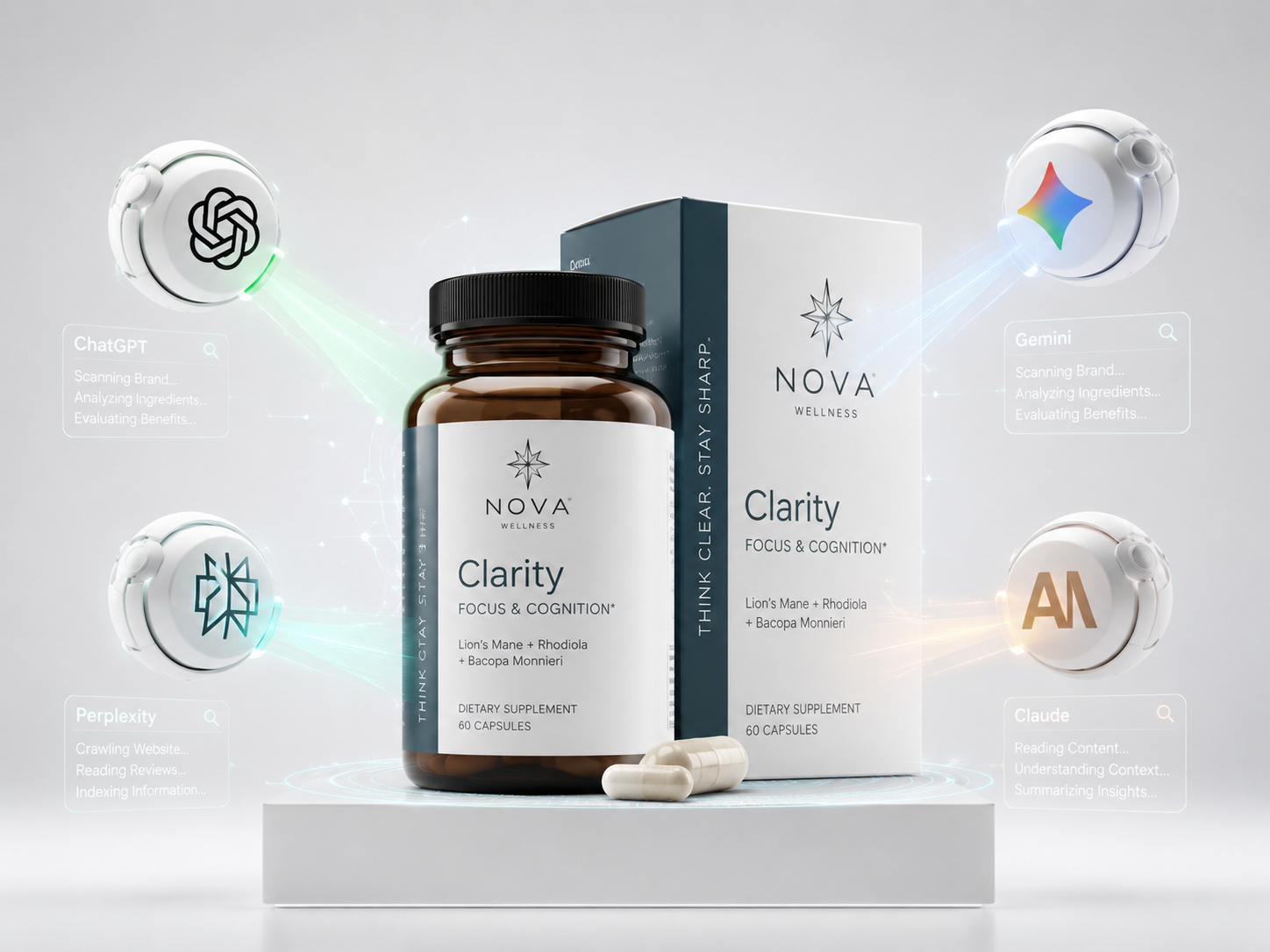
If you ask ChatGPT or Perplexity to recommend brands in your category and yours never comes up, it isn’t bad luck. It’s a set of fixable, specific signals the model can’t find. Here are the five that decide whether you exist in the answer.
Signal 1 — A clean, factual home page. Most DTC home pages lead with a hero image and a vague promise. AI engines need extractable facts: what you sell, what it costs, what it’s made of, who it’s for. If a model can’t summarize your brand in one accurate sentence from your own site, neither can a buyer.
Signal 2 — Consistent entity description across the web. If your site says “premium skincare,” a directory says “beauty products,” and a review says “cosmetics startup,” the model sees three blurry entities instead of one sharp one. Pick one description of who you are and repeat it everywhere, verbatim.
Signal 3 — Schema markup. Without Product, Organization, and Review schema, you’re asking machines to guess your facts. With it, you’re handing them the facts. Most of your competitors haven’t done this, which makes it a fast advantage.
Signal 4 — Third-party corroboration. A brand that only describes itself is weakly trusted. A brand described consistently by credible outside sources is strongly trusted. Earned coverage, structured reviews, and citations are how you cross from “claims to be” to “is.”
Signal 5 — Original, specific, quotable content. Generic content gets ignored; specific content gets quoted. Numbers, comparisons, ingredient breakdowns, and original data give the model something to lift with your name attached.
Run the test now: open an AI engine, ask it the question your best customer would ask, and see what comes back. The gap between that answer and your brand is your roadmap.

Leave a Reply